Can You Use Baby Oil to Polish Your Boat
Let's say that the gelcoat on your boat looks less than stellar—as in chalky similar a chalkboard less than stellar. Perchance your bluish gunkhole at present has a purplish hue, or your topsides don't reflect annihilation other than poor care. The good news is that the damage is reversible, in most cases. The bad news is that you have a lot of work ahead of you.
Whether you're trying to prep your gunkhole for sale or rehabbing a new acquisition, or only sprucing up your current ride, restoring gelcoat shine not but makes yous feel better, information technology really enhances the value of your gunkhole and helps to make it terminal longer. It's besides 1 of the easiest things (from a technical standpoint) you can do on your boat yourself.

You might accept a lot of folks tell you that y'all can go away with using one-pace waxes and snake-oil treatments that guarantee a great smooth, but the truth is, if you take a badly oxidized gelcoat finish, the method yous're going to read about hither is exactly how the pros would do it if you hired the job out yourself. It requires some specialized tools and materials, but y'all can salve a good amount of money doing it yourself. If you have light or moderately oxidized gelcoat, have a look at this video, which explains the steps in removing that light oxidation from your gunkhole.
Tools of the Trade
The first step in whatsoever gelcoat restoration job is removing that layer of oxidation continuing between you and a good shine. And if that oxidation is heavy, I'm not going to lie to you—merely a machine will go it off. You can employ a household electric drill with a retrofit buffing pad if yours is a small project, but if you need to compound anything over twenty feet, a seven-inch bending grinder with the correct buffing pad (3M's Superbuff is a skilful one to try) is the tool to get. Expect to pay around $200 for a skillful-quality one, or you can also usually hire them for around $30 a day from a tool rental store.

Getting Started
Earlier we get started, we'll assume your gunkhole is out of the water or on a trailer, because it's virtually incommunicable to restore a faded gelcoat hull while a boat is in the water. (If y'all're just working on the decks and interior portions of your boat, you can certainly accomplish that while the boat is floating.)
First, give whatever gelcoat surface yous'll exist compounding a good wash, and then let information technology dry out. If it's especially dingy, use a heavy-duty cleaner such as Krazy-Klean or On and Off. Once you've gotten the dirt out of the way, it's time to break out the rubbing chemical compound and machinery.
Compounding
The first step in the procedure involves using rubbing compound, which is generally a mineral-spirits based liquid or paste with fine annoying particles suspended in it. When you "rub" in a rubbing compound (or polish it in with a machine), it slowly removes all of that nasty gelcoat oxidation from the surface. Do it long enough and y'all polish in a dull shine. The objective in this step is not to go a high-gloss smooth, merely to remove all of the oxidization and prep the surface for a finer polishing. Now, if your gelcoat is scratched or gouged, you'll want to make those repairs before getting started.
The key when compounding is to not to fling compound all over your boat or your neighbor's gunkhole when you fire up the grinder or drill. The way I accomplish this is past not applying the rubbing compound to the buffing pad, but to the gelcoat itself beginning. Y'all can reach this past loading a small amount of compound onto a rag and then smearing it into a workable surface area of gelcoat.

Adjacent, work the compound in with the automobile at slow speed, and in short bursts, to avert overheating the pad. Work back and forth in a pocket-sized area until you feel equally if you've given equal handling to the entire surface. Every bit the compound dries, you can wipe information technology off with rags as you go forth, repeating the compounding until you feel equally if you have all of the oxidation removed. Working in pocket-sized areas is key. The hull won't shine similar a new penny at this point, but it shouldn't take any hazy spots, either.
Polishing
After you feel like y'all have the oxidation dealt with, it's time to actually polish the surface to a glossy smoothen. That's where 3M's Perfect-It Motorcar Shine comes in. This material contains abrasives like the rubbing compound does, simply they're much effectively, meaning that they'll deal with whatsoever swirl marks left behind past the compounding, and bring the shine level way up. Utilise it and work it in exactly like you did with the rubbing compound. Echo as necessary in areas where the smooth doesn't fully come.
If you're really a glutton for punishment, you can finish this step off by going over the entire surface with 3M'south Finesse-It polish, which has an fifty-fifty finer level of abrasive content in it. Equally with the other materials, use it and work it in, repeating as necessary in areas where the polish doesn't fully break through.
Wax On, Wax Off
The last stride in your gelcoat recovery is probably the most satisfying. Now'southward the time to use good liquid or paste wax that will bring up that final high-level shine and protect your gelcoat from clay, salt, and dominicus. I like Star Brite's Premium Marine Smooth with PTEF or 3M's Ultra Operation Paste Wax, simply use your favorite, if you accept 1. Or, bank check out some of our recommendations in this handy article on waxes and polishes.
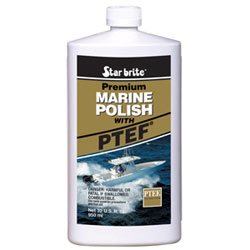
Information technology'due south always better to apply wax in thin coats versus applying i thick globby one, and you should use at least two coats to final a flavor. Yep, I know, at this bespeak you're pretty exhausted with this process, but the improve this terminal glaze of wax, the longer that dainty new shine you've worked then hard for volition last. Use a clean rag or foam applicator (bachelor at most marine or automobile shops) to use a thin glaze of wax to the surface, and and so wipe it off once it has dried. Repeat until your arms fall off. It's that like shooting fish in a barrel.
Voila! At this point yous should accept a sleeky, durable shine that volition make you the envy of your local waterways. To keep it up over the years, utilize a couple coats of good-quality wax in one case or twice a flavour to keep that new-boat smooth.
Boat Trader has plenty of Buying and Selling advice, simply likewise check out the hundreds of manufactures in the Boating section, with tips on everything from seamanship to maintenance, how-to, where to notice replacement parts, and much more.
Source: https://www.boattrader.com/resources/restoring-gelcoat-like-pros-elbow-grease-required/
0 Response to "Can You Use Baby Oil to Polish Your Boat"
Post a Comment