whats it like to live in the texas panhandle
The Panhandle, Texas' Siberia. Misunderstood and unloved, information technology is an unlovely hinterland best suited for pioneers or pariahs. Nature gave it few trees, no visible water, and animals and plants equally unhospitable every bit the terrain; and so a handful of humanity happened along and added industry that was smelly, messy, and hard. The Panhandle is bleak, lonely, and far abroad, and it is my favorite function of Texas.
I was built-in there, truthful, in Pampa. I've taken my share of guff near my hick upbringing and take even bemoaned it myself. Just despite information technology all, my childhood memories remain untarnished. Growing up in the Panhandle meant running costless. There were countless creek bottoms, mesas, gullies, prairies, and oil leases to roam and explore. My sisters and brother and I had an abundance of and a fascination for everything, creature, vegetable, or mineral. The Panhandle lacks a lot in the cultural and social departments, only it was the best place in the globe to be a kid.
As I grew older, though, the Panhandle began to seem small-time. Information technology was the sort of place that a newly hatched adult, her head full of worldly aspirations, could not abide. I moved to the city and made a life in that location, only in the seventeen years I have been abroad, the Panhandle has haunted me. Finally, after years of journeying dorsum and forth to visit my family, I fabricated up my mind to call on a sampling of Panhandle types—farmers, cowboys, oilmen, and such—to compare the reality of their twenty-four hours-to-day lives with my childhood impressions. Only as I've grown older and begun my own family have I felt the demand to accept a serious expect at the place or to know the people who, unlike me, decided to stay.
The Top O' Texas
The Panhandle has 26 counties. (Some say 32, merely the region is square, non rectangular. Sad, Littlefield, Plainview, and Muleshoe.) It has some 390,000 people in 26,000 foursquare miles, or two per centum of Texans in 10 pct of Texas. It is embroidered with all the classic Texas details: cowboys, cattle, oil and gas, wilderness, western-movie panoramas. Yet for all its typical Texanness, the Panhandle's inhabitants keep not only a physical but also a mental distance from their more than sophisticated counterparts downstate. The Panhandle is closer in distance and in spirit to the capitals of Oklahoma, Colorado, and New Mexico than to Austin.
Except for Amarillo there are no cities, simply modest towns where kids on bikes deliver the paper, Coke machines manipulate bottles, and water towers behave the names of the local high school teams. Here you can greenbacks a bank check without an I.D. and dial simply the last five digits of telephone numbers. (My parents think in 1954 when DeLea Vickers, a Pampa pioneer, fumed nigh the newfangled dialing because he had to give up his longtime phone number, 1.)
Pampa was, of course, the first stop on my nostalgia bout. The constants were all the same at that place: the rodeo grounds, the ruby-red-brick streets, the Santa Fe rail thousand where we had played on the handcar and mashed pennies on the tracks. Just a bank has supplanted the infirmary where I was born. The Woolworth'south where I did my Christmas shopping for a decade was now a furniture store. And Caldwell'southward, the favored drive-in of my mean solar day, long agone roughshod victim to a Burger Male monarch.
Landmarks bated, Pampa has niggling to do with my memories. The country held all the romance. Nosotros chased downwards tiny horny toads the size of a man's thumbnail and caged them in matchboxes until someone took pity on them and set them free. We had one as a pet once, Horatio, whom we housed in a shoe box and kept live until the tragic twenty-four hours he was dispatched by his own dinner of red ants. Another pet was Cowboy, a tarantula then named for his bowlegged stance. He occasionally broke complimentary of his pickle jar and terrorized my mother'south bridge club.
And, naturally, we had the weather. The dryness of the climate gave us a lifelong appreciation for pelting, and in wet weather we danced about outside till we were soaked. The unceasing wind never bothered us, and coming from the right direction, it could be relied upon to provide one heck of a swing ride. At night while it whined we told ghost stories in our bunk beds. If the wind picked up during the solar day, Mother would pin quilts to the clothesline, and we would huddle in this makeshift cabin and pretend nosotros were hardy pioneers. Sometimes the sky would plough a weird yellow, and a sandstorm would fling tiny needles right through the walls and eventually bring the whole playhouse tumbling down. Then nosotros pioneers would brand a break for the back door, where just within nosotros would pour a loving cup or two of grit out of our shoes earlier Female parent would allow us all the way in.
We took regular Sunday drives, begging Daddy to drive through the dust devils. At farms and truck stops we examined the selection of insects smashed on the machinery grills. We deciphered the brands on ranch gates—Rocking Chair was our favorite—and made upward names for our own imaginary spreads, like the Buzzard Slump, with its brand of a backward, sloping South. We went rock hunting and prized equally an arrowhead whatsoever piece of flint that was roughly triangular. We had contests to meet which team of two could count the most pump jacks on its side of the road. Occasionally, we would stop where an elevated gas pipeline spanned a gully, and nosotros would cross it, balancing with our artillery like the Great Wallendas.
Our favorite picnic spot was Black Widow Bottom, a footling clearing near Lefors where a huge cottonwood ever contained ii or three of the title characters in its giant knothole. Nosotros took turns perching on the limb nearest the knothole and gazing, mesmerized, at that evil sorority with their swollen egg cases and gleaming legs and menacing scarlet hourglass bodies. When we finally tired of watching the spiders, we played in the creekbed, which joins the Northward Fork of the Red River. The bed was always bone-dry, leaving a jigsaw puzzle of dried mud that provided palm-size pieces only right for flinging at a cow. On the way abode we urged Daddy to catch up with the water mirages.
When I was in high schoolhouse, my friends and I headed out of boondocks in whatever direction until we plant a suitably deserted oil lease track or farm-to-marketplace road. There we would pull out our smuggled alcohol and sample it in peace; if need be, we had plenty of fourth dimension to hibernate the prove because nosotros could spot headlights ii miles abroad.
2 of our favorite hangouts were nigh Bowers City, 10 miles from Pampa. One had its own legend, something involving a murder, a grave, and a hanging tree. The boys raced each other down the cliff while the girls oohed appreciatively. The 2nd place was an Amoco lease, or, as nosotros knew it, Screaming Wells, a deep fissure of a gully whose banks were dotted with pumping units. When the air current cranked up and whistled across the empty standpipe, information technology fabricated an unearthly screech and gave united states good reason to cuddle closer.
Being scared was a big function of our dark adventures. We shivered when an owl hooted or the brush rustled. The current of air—there was e'er wind—brought with it the faint reek of chemicals or cows and the eerie, rhythmic crepitate of machinery. 1 friend of mine, while parking with her young man on a deserted road, turned on the headlights to discover strung up on the fence in forepart of them a long row of coyote carcasses. Maybe that's why she graduated a semester early on and headed to UT.
The Breaks
Nature is not friendly, and the Panhandle is composed mostly of nature. The sun blazes, buzzards circle, stickers lie in wait. The about rugged region is along the Canadian River, where the land breaks up into bleak caliche hills, eroded carmine clay cliffs, and myriad small canyons that plough in upon themselves like braids—the Canadian breaks. The ground is impossibly rough, begetting nothing more than decorative than cholla skeletons and bleached slabs of dolomite.
Nevertheless for all their inhospitality, the breaks were inhabited long before the balance of the Panhandle. On individual land eight miles off U.S. Highway 385, in Oldham County, is Landergin Mesa, an Indian high ascension 160 feet above the Ranch Creek feeder of the Canadian River. Atop the mesa, beginning most the year 1100, peaceful Indians built stone homes, perhaps ninety of them, overlooking the river. Beneath, on the fertile banks, they grew corn, beans, squash, and tobacco to supplement their buffalo meat and other game.
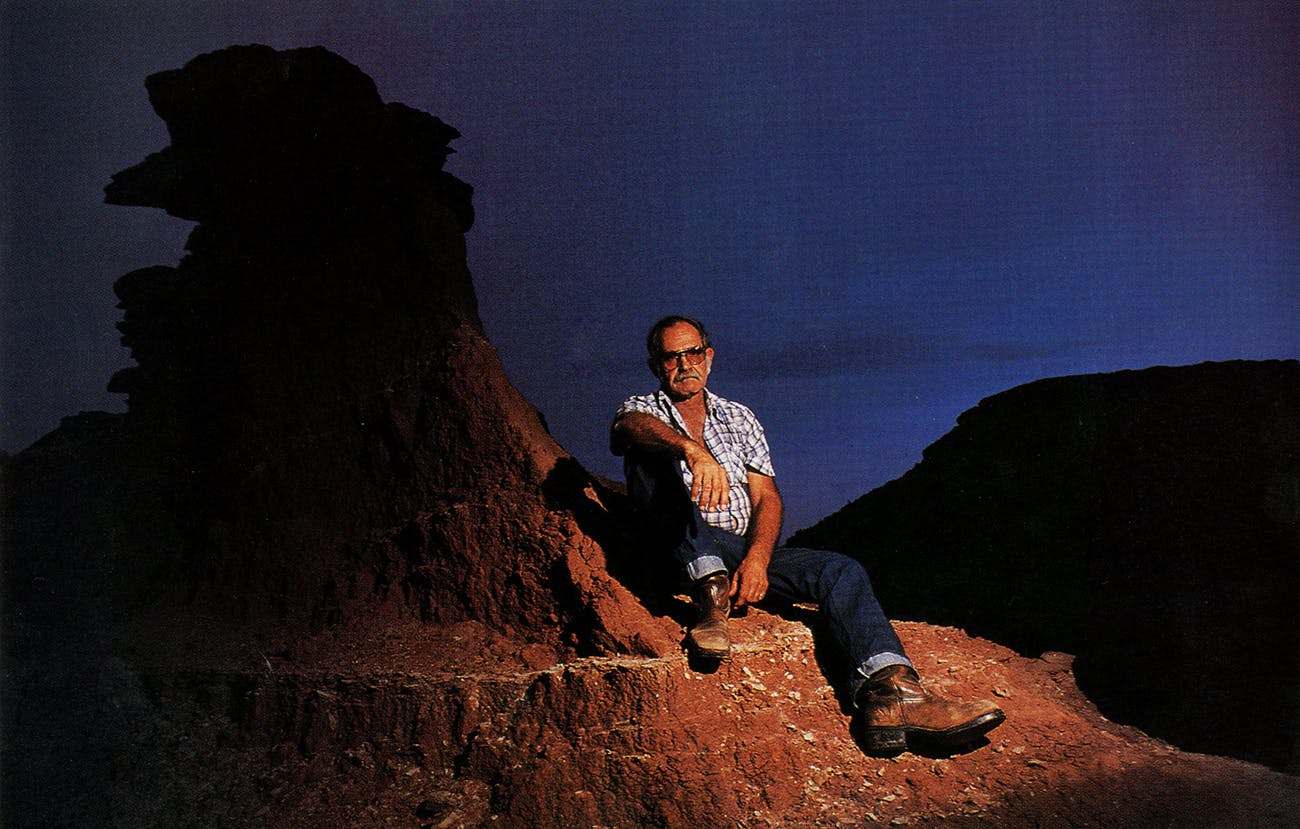
Landergin Mesa is a national historic landmark, and touring it requires an official guide. Beak Harrison, born in Coulee fifty years ago, is at present the curator of archeology at the Panhandle Plains Museum in Canyon. "Kept leaving," he said. "Kept coming back. Finally stayed." Bill has tousled greyness hair, boots that have earned their keep, and a fearless driving technique. The 24-hour interval of our trip to the ruins, the dirt road was gluey from recent rains. After a couple of miles, we turned off onto land used then infrequently that my city optics failed to discern the rail. At a gaping creekbed Pecker switched the pickup to four-wheel-drive, and nosotros jangled across, leaving ruts you could lose a cat in. "This isn't bad," Beak said.
Equally we drew closer to the mesa and farther from annihilation resembling humanity the ruts got deeper and uglier until finally, in a stand up of cottonwoods, Beak said, "Nosotros'll whoa it right hither." The mesa was perhaps one-half a mile abroad, imposing even at that distance. Nosotros picked our way through the cactus to the base of the trail that led to the mesa top. It had taken archeologists two and a half months to establish the path, which twists and turns up the least-sheer face of the cliff, instilling an appreciation for the agility of the people who used to dash up and downwardly it.
We hadn't gone a dozen paces when Pecker halted and bent to selection up something: an arrow point. He showed information technology to me and then, to my surprise, threw information technology back downwards. Then he spotted a sidescraper, an obsidian flake, and a slice of pottery. He tossed them all dorsum into the brush. "But Indian litter," he said.
Having conquered the mesa, we were nigh browbeaten back past the wind. It was a relatively balmy fifteen miles per 60 minutes, but the keening was continuous. The just other sound was a crow'south calling far abroad. Too the little white speck of Bill's pickup, the but signs of man habitation were nether our feet.
Almost of the rock homes, crowded shoulder to shoulder like blitz-hour bus riders, were half subterranean. Dolomite slabs were embedded every bit a foundation, then built up with adobe that is long gone. Low entrances required a company to kneel and crawl in, allowing the occupant a chance to let loose arrows in example the visitor happened to exist unfriendly. The mesa was perfect for defense; it afforded a view of the country for miles. The elevation, not much more than an acre, was shared past some 2 hundred people willing to have cramped living quarters and a punishing wind in exchange for a 360-degree view of the horizon.
A huge anvil of a thunderhead was building upwardly to the s, and then Bill and I decided to escape earlier our road done out completely. In two hours we had traveled eight hundred years in time.

Call of the Coulee
For 12,000 years the Palo Duro has been the Panhandle's only tourist attraction. It is not such a chiliad canyon, just it is impressive enough, carved some one,200 feet deep by the Prairie Dog Town Fork of the Blood-red River. Like the river, the canyon is red, and rusty red of the fan-shaped lower slopes chosen the Spanish Skirts. For tens of centuries, Indians ate the coulee'southward arrowroot, prickly pears, acorns, and smorgasbord of game; they relied on the dark green juniper that carpeted the canyon (the difficult forest that gave the Palo Duro its proper noun) and hid in its caves and gullies from the sun, the wind, and the white man. It was their last holdout on the plains and the scene of their inevitable defeat.
To kids from Pampa, the Palo Duro was a common only beloved field trip; we had fun in the name of education, hunting for devil'south-claws, or unicorn plants (blackness, scaly, shrimplike pods), and desert roses (roseate gypsum in crystallized blossoms). But the real lover of the canyon is the scientist. I persuaded Jack T. Hughes, a professor at Westward Texas State University in Coulee, to read to me from the Palo Duro's open book. He identified strata and shrubbery that hid the fossils of horses, rhinos, and dinosaurs. He pointed to huge boulders full of holes used equally mortars past countless generations of squaws.
At a low launder Jack stopped, rock hammer ready, and led the way up a cliff. "Be careful," he said. "Trying to get a footing on those slopes is similar trying to stand on a tin roof covered with marbles." He skirted a sinkhole, a huge black maw in the ground that smelled like a dungeon. He risked such dangers to expect for geodes and celestite, a pretty blue stone that, similar manganese, is common in the canyon but rare elsewhere. He crushed a soft slice of gypsum, the white lace that bands the Spanish Skirt, and identified strips of agate and nodules of red hematite in diverse chunks of rock. Jack spoke of the Miocene, Pliocene, and Pleistocene epochs and so, pausing by a beer bottle, remarked, "And that's from the Obscene Age."
Nosotros huffed and puffed upwards one slope to find some of what Jack calls the local opal, a commercially valueless simply pretty bluish-white rock that runs in layers between other rocks. On the way he stopped to ogle a shine piece of dolomite on which was imprinted a pocket-size three-toed pes fabricated by some odd fauna of yore on a casual stroll. "That's pretty prissy," Jack said. "Nosotros should have that in the museum." He chewed on the sweet hulls of mesquite beans and continued his geologic dear talk: "Here are some beautiful mud cracks. At present this is your very, very vuggy opaline chert." But I was only one-half listening; I was dorsum with the aboriginal creature that had trodden on a muddy patch of ground and left his own graffiti.

Tiller of the Soil
Charlie Bowers, a ruddy, genial human being, raises corn, wheat, and milo on four thousand acres 16 miles south of Pampa, in the aforementioned place where he was built-in and raised. Actually, he has farmed for only fifteen years. Though his male parent was a farmer and both grandfathers also, Charlie never planned to be one. Simply when his begetter died, Charlie, who was off at Texas Tech, came dwelling house to help his mother with the harvest. When he finished college, he rejoined her, and even after her death Charlie, hooked on the land, remained on the family subcontract in his parents' business firm. I talked to him there, interrupted occasionally by the crackle of the two-fashion radio that is the farmer'south telephone.
"Farming is a misunderstood profession," Charlie said. "No i in an urban place has any idea how technical our manufacture has become." He refers to the varieties of grain, the fertilizers and pesticides, and the equipment. A tractor, for example, may set a farmer back $80,000. "The just thing that'southward the same now is that they've still got a steering wheel, a seat, four tires, and a motor. They're and then comfortable—and air-conditioned. Yous're actually roughing it out there on that air-conditioned tractor."
"Of course," interjected his wife, Janyth, "sometimes yous're on it fourteen hours a twenty-four hours."
Charlie owns a section and a half, 960 acres, of the land he farms. He employs a local high-schoolhouse child role time and one manus full time. The three of them plant, harvest, repair, plow, fertilize, and irrigate, sometimes working until ten at night. "My father ever said you can stay in farming longer and stay bankrupt longer than in any other concern," Charlie said. "I don't mind beingness in debt as long as I tin see if I'm progressing."
The piece of work didn't finish while I was at that place. Charlie had to check some irrigation pipe in a cornfield and invited me to go along. We climbed into his pickup—I think, under all that dust, information technology was white—and from my window I had the classic car-seat view of the Panhandle: grain fields, a perfectly matched set on either side of the route. Every bit nosotros headed downwardly narrow dirt roads he showed me a stubble-mulched field and a tilled one, a sweep plough and the more common disc variety. He pointed out the two methods of irrigation in the Panhandle, pipe and sprinkler. Similar about half the farmers here, Charlie uses the Ogallala Aquifer by gas-powered wells; electronic sprinklers are more than efficient but far more than expensive to install.
Toll is measured another way too. The aquifer that took thousands of years to make full is beingness sucked dry past a farming practice that has existed just since 1909. "They thought the oil and gas decline was big," Charlie said. "When this surface area runs out of h2o, you might as well pack it up and leave."
At the field Charlie permit the truck idle, ignoring the hand brake; the land is then flat that there was no danger it would whorl. His work that afternoon consisted of pulling on oversized plastic boots and wading down the swampy edge of the field to plow off 80-odd valves on the irrigation pipe. A farmer has a serious associate with mud; Charlie's boots doubled in size by the time he was ten rows down. "Irrigation is three times the piece of work of dryland farming," he hollered over the rush of the water. "I spend more time walking and irrigating than anything else." He disappeared into the cornstalks, boots squooshing loudly. I sat on the tailgate. All around me, taller than the pickup, loomed corn; I felt like Dorothy in the poppy fields, threatened non by sleep merely by sneezes from the ubiquitous pollen.
Charlie returned, switched to dry boots, and drove me around the remainder of his land. He talked most weather condition, the unknown caliber in farming. "Y'all can lose a crop so quick. You get every kind of weather here but a hurricane. But the weather can help you too. Sometimes a good rain helps your insect problem equally much every bit annihilation." Once, rain stunted his maize, but another fourth dimension, it hit the corn at exactly the right time and produced a lot of double ears. A farmer raises a mixture of crops to hedge his bets. "I'd like to blame it all on the weather," Charlie added. "I've made my share of mistakes. But never twice. Your retentivity is in your pocketbook."
Nosotros drove on. He pointed out maize that was "heading out" and cut open a stalk of struggling milo to testify me the swirl, the tightly furled grain head inside. He took me to the catch swimming, or tailwater pit, which collects draining irrigation water for reuse. He stopped the pickup, and we sat for a minute, gazing out over the sea of corn.
"When something goes wrong," Charlie said, "you wonder why. Farming is hard on your religion. Only anybody who farms has got to be religious. You may not beat out a path to church every Sunday, but if you don't talk to the Lord, you're kidding yourself.
"Of course, the Lord deals yous what you lot can handle. He never gives you lot a card y'all tin't play."
Cowboyin'
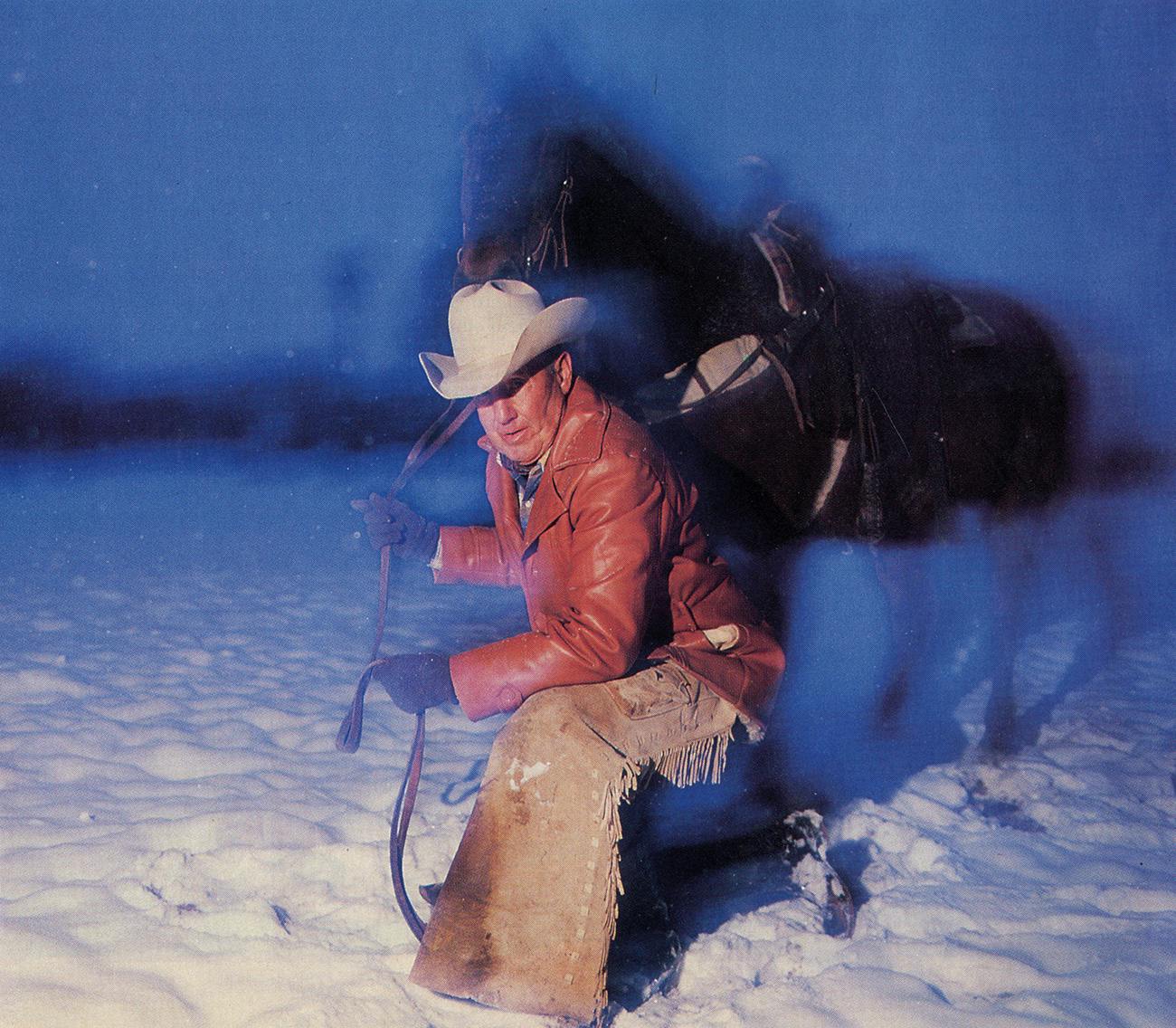
With its grass and cattle and range, the Panhandle is one of the concluding bastions for the cowboy. I've always felt proud to exist from cowboy country, still I had never so much as talked to 1. Sitting in Lefors in an all-too-rare patch of shade, surrounded by horse pens, was Tooter Henry, one of the old brood. He was wearing all the right garb: a cowboy hat and boots, a Western shirt, jeans, and a latigo chugalug. His face resembled well- treated leather. He frittered twigs with his knife. Nearby was an old chuck box spilling out gloves, rope, bits, and horseshoes and a saddle rack decorated with saddles, chaps, deer antlers with shreds of flesh still attached, and cans of Anchor Horse Spray and Rub-On insect repellent.
"Ma'am," Tooter said, "all I've ever washed is cowboy. I merchandise horses, and I break 'em and such. I simply exercise ranch work. I been here a long time." He has: 52 years, since he was nineteen. Past age twelve Tooter—no one always calls him by his given name, Clyde—had traded five hundred marbles for his first horse. He left schoolhouse, and from then on horses were his life. His first jobs were on the huge ranches of the twenty-four hours, like the Hay Hook ("There were sixty sections of that devil"), where he stayed for forty years. "Nosotros'd gather cattle, make 'em, dehorn 'em, feed 'em in the wintertime. We fixed windmills and built fence. We'd leave the ranch house about eight and not have a seize with teeth all 24-hour interval. Today it's an altogether different deal," he said. "Yous can feed 'em faster out of a pickup than a wagon, and you don't need the men you used to. Nowadays in that location ain't ane guy out of 20 that'd know how to hook upwards a team.
"You never did make much on these old ranches. Mayhap thirty dollars a month. And it wasn't any eight or ten hours either. Information technology was dark to dark, and if information technology got belatedly of an evening and at that place was something to practise, you did it. But piece of work wasn't work if you liked to do it." Tooter made extra cash breaking horses for $v. At 71 he's still at information technology, at present commanding $300 a head. He too has nearly twenty horses of his ain.
It was late afternoon, and Tooter's twenty acres were alive with the whinnying of horses reunited for the evening. He and his wife, Lois, a childhood playmate, have lived hither in their white frame business firm for 23 years. Tooter interspersed recollections with instructions to his hired mitt: "Raymond, give the little one some of that alfalfa." Lois came out of the firm, past the donkey railroad vehicle full of flowers and the gate arch graced by a aging plaster cowgirl. "Mama," he called, "come sit with u.s.a. over here." After a spell he unfolded himself and took me on a tour of his property. The horses were dining on hay—all but a frisky colt who insolently flicked his tail at u.s..
It was hot in the lord's day, so we retired to the kitchen, where Mrs. Henry poured some sweetened iced tea. I discovered from the framed pictures on the wall that Tooter had been a rodeo performer of some note. He was too small to bring information technology upward himself. "Yep, ma'am," he said. "I rodeoed a lot. My first one, I was about fifteen, mostly just helpin' out around the chute or as pickup. But I roped. That was what I did best."
In many of the photographs a younger, whippy Tooter appears on the aforementioned gray equus caballus. "Bally Sox," Tooter said with pride. "My favorite onetime horse. I give two hundred for him and his mother. Sold her for two and a quarter. He was a fine sometime boy. Two fellers offered me twenty-five hundred for him once, only I wouldn't sell."
It was suppertime for cowboys besides equally horses. Tooter walked me outside. The air smelled of liniment and fresh hay. Raymond moved a horse or two out of the path of my car. "Come back," Tooter called every bit I collection away. "You don't have to be workin'. But come on back someday."
Grass Roots
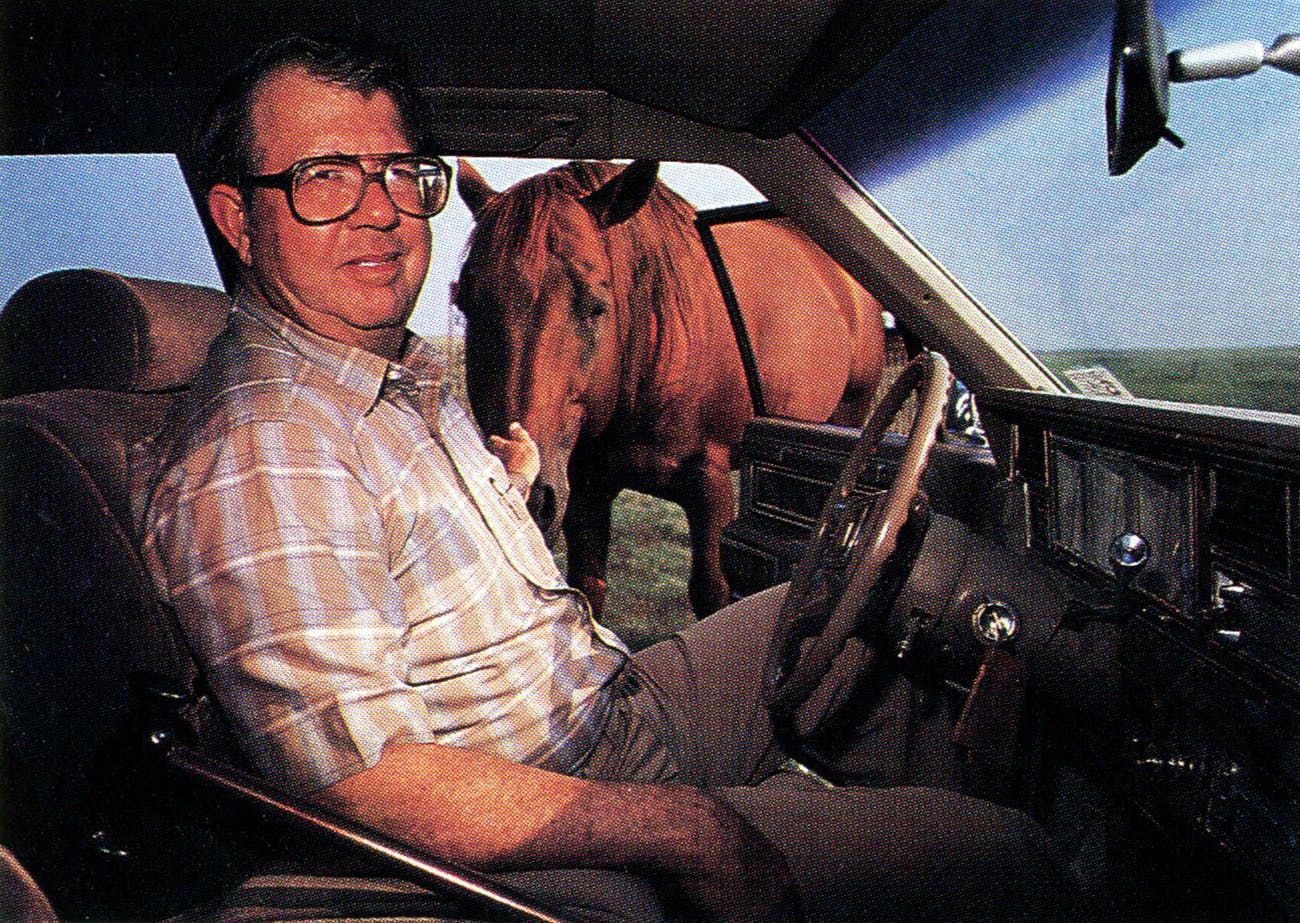
"I don't work on Sunday," H. Joe Franklin told me, "but I don't mind if yous do." A likable man with a road map of laugh lines around his eyes, Joe sometimes runs as many every bit a thou head under the Flying Cantankerous F brand on the fourteen sections of country that his family has endemic for l years. That's most nine yard acres of ranchland—"a big ranch to someone living in downtown 50.A.," Joe said, "but small past Texas standards." His father, a veterinary, purchased the land with the gain from his serum for blackleg, a fatal cattle disease. Today the Franklin vaccine is used everywhere, and blackleg is no longer a threat.
Joe has worked on the ranch all his life. He raises yearlings, which are less trouble than cows and calves. His cattle are what he calls "number 1 Okies," mixed breeds with a mishmash of characteristics. Sometimes their ancestry is recognizable, and they are identified by the breed they almost favor: "That Hereford is kind of dumpy and pocket-size. That Charolais is more similar what we want." A rancher's goal is to fatten his cattle. "You keep feedin' 'em, or you lot sell 'em, whichever your banker votes," Joe said. "Information technology's not hard, this business. If you buy 'em right, feed 'em right, and sell 'em right, yous might not lose too much money."
At his busiest, Joe runs two herds, rotating them amongst five pastures to foreclose overgrazing. All he feeds them is grass, ten or and so acres per animate being, plus some protein supplement cubes. "Grass is so basic," Joe said. "It'due south your feed. And it's inexpensive." He knows Texas grasses downwards to their roots. As we barreled across his holding in a carryall—not letting the absence of a route end usa—he identified 3-awn, with its tribristled ends; four varieties of the hardy, upright bluestems, the nigh common grasses in Texas; another grass dynasty, the gramas (including sideoats grama, our state grass); and bottom types, similar switchgrass, wild rye, and the uncommon sand bluestem.
Sand bluestem isn't mutual because information technology is what ranchers call a decreaser—under prolonged grazing it disappears. The but dodder of information technology we saw was in an former, unused roadbed fenced off from the herd. Joe Franklin's constant dilemma is to prevent good grasses from being grazed out while keeping poor grasses from taking over. An increaser, such as three-awn, is a so-so species that responds favorably to grazing and spreads chop-chop at the expense of more desirable grasses. Joe maintains "residuum areas," such equally an empty branding pen, to sentry what nature does unhindered. Inside the pen the grasses were shoulder-high and lush compared with the munched-down rangeland.
Joe loves other flora likewise. He knows the flowers, weeds, bushes, and copse on his land. West Cantonment Creek, which crosses his country, is given away by the curtain of cottonwoods, locusts, mulberry, and elm along its banks. He pointed out an imposing black walnut tree ("the old patriarch"); a dear locust ("I don't believe you could climb it if a bear was chasin' you"); and a button willow, decorated with niggling xanthous bobbles similar bedspread fringe ("I never found anything good to say about a push willow"). The wealth of trees helps make the Franklin ranch truly pretty—not the usual adjective applied to Panhandle scenery.
The ranch firm overlooks the creek. It is a good-sized habitation that the family calls Early Serum Visitor, after the successful blackleg vaccine. The firm is 1 of many buildings scattered like soapweed on the ranch: stables for xx cutting horses, the original farmhouse (circa 1900), a toolshed, kennels, a trailer house for the seasonal assist. There is a big barn for hay storage and the clangorous shop, where Joe knocks together his inventions. "Well-nigh of 'em end upwards in the junk pile," he insists, but i success is a cattle cube feeder, a contraption mounted on a pickup that automatically dumps a sure amount of protein-and-salt cubes equally the tires plough. Others are a windmill with a cable instead of a strong rod, a quail feeder, an former brush chopper ("1 of my unfinished symphonies"), and an oil-drum chariot for breaking horses to harness. Joe too says he built the showtime barbed-wire roller 30 years ago. The barbed wire, looped around a jeep wheel, is unwound every bit the vehicle moves. It was a lifesaver in a land where wire-stringing is an eternal chore.
Having lived on a ranch for and so long, Joe has amassed a wealth of facts and tidbits. Equally we bucketed forth, he told me that moo-cow chips are the hardest things to extinguish in a prairie fire and that you lot can fish a tarantula out of his hole with a wad of chewed bubble gum on the end of a string. He identified wild plums, which are great for jam, and snow-on-the- mountain, which is a favored quail chow. He knew light-green Russian thistles (posthumously called tumbleweeds) and aromatic sumac (also called skunkbrush). Joe had done his homework on his foe and co-worker, nature.
He waved an arm at the sweep of land before us. "A hundred years ago I would accept been an Indian and ridden around looking at grass and buffalo," he said. "I'm not too impressed with what human'southward washed."
Luck of the Drill
When I was a kid, I used to wonder why the Panhandle wasn't covered with those Eiffel Belfry–looking derricks that announced on state-map identify mats in coffee shops. They looked and then dramatic, only all nosotros had were pumping units, black and a little rusty, salaaming creakily like old, obsequious crickets. Oil and gas is simply a dingy, evil-smelling industry, to anyone without royalties, only it had its dramatic side in one case, and a lot of Panhandle folks think that time. One of those people is Lawrence Hagy, 88 years old—"born in the last century"—a veteran of the Borger oil nail. The manufacture took him a long style. In his office in Amarillo'south Start National Depository financial institution, where he even so checks in every day, is a map of Gray and Carson counties showing his leases in pink; the overall effect is practically roseate. Behind his desk hangs a painting of his first well, and nearby is his official 1948 mayoral portrait.
Hagy, every bit everyone calls him, is a big, cheerful human being with manners and attire too polished for a roughneck, but that's how he started out. He moved steadily up, advancing to tool pusher before he decided information technology wouldn't injure to have a geology degree from the Academy of Oklahoma. "At that time geologists were something new. Now they're only about one jump ahead of a doodlebug expert," said Hagy. "Just companies were hiring geologists then because they were learning that oil accumulated in structures. When I graduated, I went and asked my dad which company he thought was the all-time. He said, 'Lawrence, if you tin make money for them, y'all can make coin for yourself.' So he furnished me a trivial money, and I had a little money, and I came out to the Panhandle, because I'd read well-nigh all the gas out here but no oil to be found, and bought some leases, which are now in the Borger oil field out here."
The discovery changed the Panhandle. In that one year, 1926, the Borger oil field produced 26 million barrels of oil; the twelvemonth before, information technology had produced a mere million. In 3 months 30,000 people poured into the Panhandle, creating Borger in the process. At that place was money in the air, and everyone wanted a piece of information technology.
Hagy once had to pay hugely inflated fines to the sheriff and guess to bail out his unabridged derrick coiffure, who had been arrested for carousing. And though he was lucky enough to own a business firm, Hagy liked the tent urban center of Borger with its "debutantes," drunkards, and con men. "Information technology was just a-bravado and a-going and only every bit broad awake at iii in the morning as information technology was at ten o'clock at night," he recalled.
Hagy caused ii partners, Don Harrington and Stanley Marsh, Jr. "Harrington was a proficient landman and handled the office work. Marsh could go along with the farmers and ranchers well and was out in the country ownership leases. Frankly, I don't recollect I e'er did very much. I just had a lot of friends." The partnership flourished; in one example the three men caused 10,000 acres for $i an acre, and then resold the land to Humble Oil for sixteen times as much.
At beginning Hagy could make money from oil but not gas. "It was simply like golden on a desert island," he said. "If you lot couldn't sell it, it wasn't worth annihilation. We had the gas out here, and they needed it in Kansas City and Indianapolis and Chicago. Simply the companies that owned the big pipelines wanted to take their own gas and non give u.s.a. a market place. They didn't want to pay us."
In 1933 Hagy went before the Legislature to argue the instance for proration, which would ensure that even smaller operators in an oil field were compensated for their share of the field'due south gas production. Proration is gospel today, just back so it was heresy, and Hagy's endeavor failed. And then he returned to the Panhandle and took on the pipelines in the field. "We built a gasoline institute over there, and just took the gasoline out of the gas, and blew the residue to the air, which was very wasteful," he said. "After that went on for a year, the companies decided it was better for them to preserve the reservoir and to take gas from everyone." Every bit a result, Hagy and his partners got a nice contract for their gas, and like well-nigh in the fuel-rich Panhandle, they easily survived the Keen Low, which devastated the rest of the dust bowl.
Hagy not only survived; in 1940 he bought an involvement in the First National Bank. During Earth State of war II he was deputed by the Air Force to advise the Soviet Union on rebuilding its bombed gas lines. He ran for mayor of Amarillo and was elected handily: "They didn't know me very well, I judge." During his term Hagy, e'er ahead of his fourth dimension, pushed for the Canadian River dam and reservoir that supplanted the Ogallala Aquifer as Amarillo'due south domestic water source.
Like all oilmen, Hagy loves land, and he owns the 38,000-acre Bitter Creek Ranch, a "horse pasture" that one time belonged to the legendary cowman Charles Goodnight. Hagy runs a few head of Hereford, merely, he said he can't make any money ranching. "At present, you can be a success in the oil business organisation and be rich," he said. "I similar my concern. I was just lucky. I've always been lucky. And it happened right in front of me."
Future Steaks
I can remember explaining to a Northern visitor what feedlots were and hearing her exclaim, to my bafflement, "Oh, poor cows!" I didn't regard cows as poor or anything else. Cows meant ii things to me: beefiness and stink. The latter comes from the Panhandle's many feedlots, where cattle are fattened up to practise their duty. You can smell a feedlot miles away.
Midway betwixt Pampa and Wheeler, on the site of a World State of war II air base, is Moody Farms, its pens built atop a mile-long runway. It is a relatively small operation, fattening twenty,000 head of cattle a year. Its manager, King McAnelly, who has a wide smile and a girth to match, told me that most of the cattle are crossbred and come from Eastward Texas and as far away equally Florida. The feedlot contracts to fatten them for their owners. When shipped in, heifers weigh about 550 pounds and are priced at 70 cents a pound; steers, well-nigh 100 pounds more at 75 cents. That's $14 million worth of beef on the hoof, which requires some $3 one thousand thousand worth of feed and drugs annually.
Moody Farms grows, mixes, and produces its own feed. Steve Alexander, who described himself every bit "20-viii and wore out," ran the mill the 24-hour interval I visited. Lanky and laconic, wearing a gimme cap with "Beef" stamped on the silhouette of a cow, Steve had worked in feedlots for ten years. His discipline is a corrugated-steel palace with kernels crunching underfoot and the moist, sugariness odor of hot grain hanging in the air. Outside, two tall granaries store half a million pounds of raw milo, which is four days' supply.
Inside the steam room, the milo is cooked and rolled. At the control area, a unmarried worker sits in front of a console that looks like the dashboard of a Buck Rogers vehicle. He inserts a calculator card, and the right dosage of antibiotics and fly-control drugs is added to a gigantic mixture of cooked grain, protein supplement, alfalfa, molasses, and fat. The last mixture is poured through a giant funnel into waiting trucks that dispense the feed into troughs, or feed banks. The mill mixes 35 batches a day of the bovine porridge, seven days a calendar week. The mixture is so rich that new cattle get boozer on it; to prevent this the cattle are first fed hay, and so introduced to the grain little past little.
The large challenge in a feedlot is to continue from running out of food. Moody Farms employs several easily to check the feed levels, because if the feed runs out, the cattle will overeat when it reappears and get drunk all over once again. During my visit, a recent rain had rendered supper inedible, and the hands were busy shoveling it out. The feed banks border the pens, each of which holds a few hundred head and receives five tons of grain a day. Manure is everywhere; workers periodically make clean up with a front end-end loader.
Steve and I made the rounds in his pickup, and he pointed out the difference between residents of various pens. The sometime-timers were fatty and stolid, mouths rotating without interruption; the others, newcomers, were thin, listless, and "poor equally snakes," Steve said. "When you get 'em similar that, you lot can't inappreciably keep 'em live." We collection past the vaccination shed, formerly the hangar, and the hospital shed, where each patient is doctored upwards more an only child. "And then far this calendar month nosotros've simply lost fifteen head," Steve said. "I lost 90-9 my first month. These green southeastern cattle come up in sick from a warm climate to this freezing place up here." Exterior was a dead cow. "Need to exercise an autopsy on him," Steve said. The cause of expiry could be polio, encephalitis, pneumonia, or respiratory trouble. The carcasses attract coyotes, which skulk around the feedlot at night.
When we drove dorsum to the office to rejoin Male monarch, I realized I hadn't smelled annihilation in an hour; my olfactory system had shut down in self-defense. Every bit nosotros passed, the cattle looked up with colossal disinterest before returning to their supercharged feed. I might accept felt sorry for them if beef didn't taste and then proficient.
Voices From the Past
Male monarch McAnelly, like many Panhandlers, diversifies. To survive, if not succeed, y'all have to, because nearly area industries are at the mercy of nature. Rex owns a thousand head of cattle at the feedlot, only he's a farmer too; he owns some 2,500 acres of land, a good bit of it planted with wheat.
Most of Rex's land is leased to Moody Farms for raising feed grain. Driving around in his three-quarter-ton pickup, he stopped to adjust the electric sprinkler arrangement on a wheat field and to shut off a well, and he detoured by his picnic grounds about Sweetwater Creek. There are two charcoal-broil grills, i unused since a pack rat moved in; Rex doesn't accept the centre to adios him. On a bois d'arc log was a giant web; its resident spider raised a foreleg in greeting.
We collection on, and King showed me his grandson's land. "Your grandson?" I asked. "How old is he?" Rex was also young to accept a farming grandson.
"Xiii," Rex said, "and I'll be glad when he's former enough to sign the notes." He waved a hand at a sweep of the tortilla-flat footing. "That'southward the kind of land that just holds the globe together."
Rex has in full measure the mutual Panhandle regard for the country likewise equally its history. He showed me a ane-room school and a "whiskey strip," an unclaimed slice of land said to be created by a surveyor's drunken mistake. He ran me by the Old Mobeetie jail, the get-go in the territory, and Old Mobeetie itself, at one time the self-styled Female parent Metropolis of the Panhandle. On a half-section of King's ain country, the deed to which is signed past Theodore Roosevelt, lie the ruins of former Fort Elliott, built in 1875 to protect the buffalo hunters from the Indians.
Today the fort is no more than a heap of broken bricks and some stone steps leading nowhere, but information technology's the merely reminder of the greatest boon in Panhandle settlement before irrigation. A apartment field of buffalo grass was the parade basis; an surface area pockmarked with rusty $.25 of metal, the smithy. Rex gave me a brick from the billet and a muleshoe, longer and skinnier than a horse's. "Here you go," he said. "A paperweight and a good luck charm."
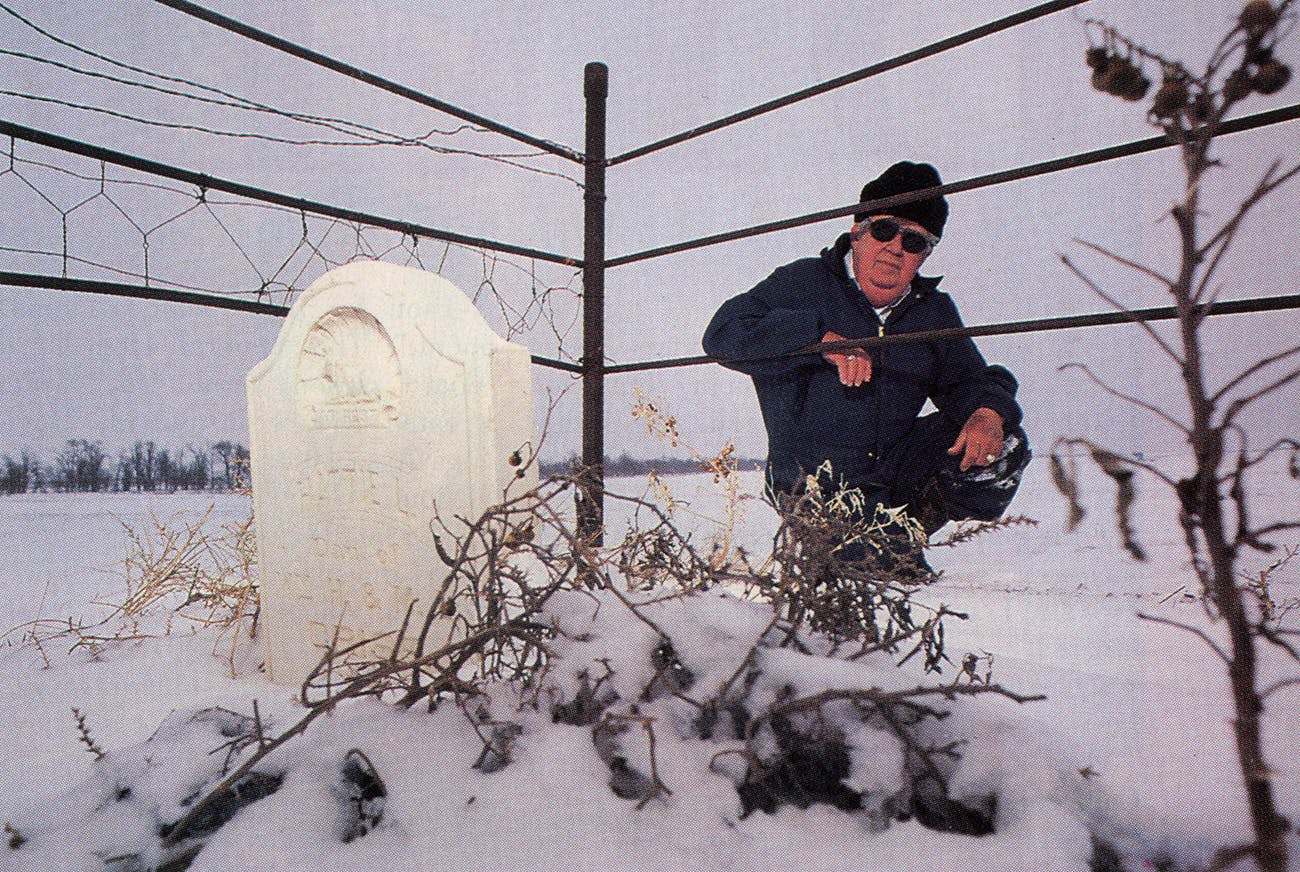
He had one more thing to show me, and we barreled on down the rutty roads to a tilled field set to be planted with winter wheat. He headed straight across information technology, following the tire marks left by an earlier visitor. "Life's a lot easier in someone else's tracks," he said. He stopped in the middle, where on a ascension stood a white lamb-topped tombstone: "Hattie, daughter of Wm. H. and M. L. Well-baked, July 31, 1887. Anile 7 mos. 18 ds. At rest."
"Nosotros'll never know if she was the daughter of someone coming through or someone from the fort," Rex said. But information technology didn't matter. He fenced in the tiny grave, and today all effectually it grow reminders of a hard-won Panhandle civilization.
Political Asylum
One of the persistent Panhandle myths is its bleakness, its dry, dusty wastes. Those exist, of course, and they are the nigh familiar; wouldn't yous build the highway through the flat part? Simply there are plenty of oases. The Panhandle is dotted with trivial wooded patches where the traveler can have shelter from the overwhelming emptiness. Creeks were the best places for plants and animals, and everybody has his favorite.
I had come to Chicken Creek to talk to a 18-carat hermit, a Panhandle native who so thrived on the Panhandle'south combination of shelter and wilderness that he retired here 26 years ago, preferring the companionship of Craven Creek to that of lodge's. The creek is the site of a famous Indian massacre and not far from prime pronghorn grazing grounds. Nether a warm winter sun the creek babbled, the insects droned, and 2 mule deer leapt out from the waterside shrubbery and fled, spooked by the sound of my car.
Mickey Ledrick comes from pioneer stock and was a pioneer himself in Texas' Republican party. In 1950 he volunteered as campaign manager for Ben Guill, a Pampa man who ran for Congress as a Republican. Mickey had admittedly no experience; he recalled that he would "go from town to town and collar people on the street," pleading for votes. Information technology worked; Guill won, becoming the second Republican congressman from Texas at the time.
From there Mickey quickly moved upwardly the political ladder: he staged Dwight Eisenhower'southward 1952 campaign in Texas, moved to Washington to become an assistant postmaster general, and in 1955 became both an banana to the chairman of the Republican national commission and the executive manager of the Texas Republican political party. Merely in 1961, later on helping John Tower succeed to Lyndon Johnson's U.South. Senate seat, he abruptly left politics, moving to a section of family land on Craven Creek 25 miles from Pampa. "I wanted to get away from people" is all he offers by way of caption. He has lived here always since, most of the fourth dimension without a phone. He likes the solitary life.
But he isn't really alone. Deer, squirrels, turkeys, and raccoons know him and eat out of his hands. He provides grain, nuts, and seeds for them, getting up earlier they exercise to ready out breakfast. He spends as much as $250 a month on groceries for his creatures, more than than he spends on himself. As nosotros talked, a squirrel gestured, annoyed, at the empty feeding cans while a turkey hen disgraced herself past losing her grip on the railing.
The deer are Mickey'south favorites. Most xx besiege on his front end lawn for breakfast, and in cold weather every bit many as xc appear in the food line. They regard him as their protector, pawing at the door to have him remove cactus spines or porcupine quills. His favorite doe, Mama, lets him know when a predator is too close for comfort. One time he heard her warning snort and stepped quickly to the door. "Here came that bobcat," he said. "He had his ears laid back and his tail between his legs. So I thought, 'Wait, bobcats don't have tails.' It was a mountain lion. That lion tore the breadbasket out of one of my babies." The mountain panthera leo returned to lurk virtually his place for vii to eight years, once with two cubs, and "no ane believed me but the game warden."
During hunting season Mickey keeps a predawn vigil by the highway to watch for poachers. "Once, at five-fifteen a.m., I found a pickup parked within my cattle guard. I got out my thirty-thirty. The hunter said, 'You seen any withal?' I said, 'No, y'all're the offset.' " Mickey himself has never killed anything except a rabid badger and a skunk family of five who moved in uninvited under the house. "There's a skunk graveyard over at that place a ways, and my conscience still hurts me."
He has had enough of opportunities to get out his place, among them offers to work for Goldwater, Nixon, and Reagan. Merely he is content with his life, his country, and his animals, although his one-time cronies don't understand. "The state vice chairman and her husband showed up ane 24-hour interval. I fabricated 'em some coffee, and then I went out and chosen upwards my deer. I said to 'em, 'Now, before you start on this pitch, practice you think I'd leave all this, and go back into the wild life of politics?' "
For his visitors, the question was unfair, but if the Panhandle is in your blood, the answer is all too clear.
Source: https://www.texasmonthly.com/being-texan/this-land-is-my-land/
0 Response to "whats it like to live in the texas panhandle"
Post a Comment